
Mulebuy Spreadsheet Comparables: price a find against listings that sell the same kind of thing
Search the catalog, pick a shelf, then hold any find up against three to eight listings of the same kind before an agent buys it for you.
Start on a shelf
Sixteen shelves, each with the first specification to match when choosing comparables. See the detailed comparison notes for every category.
 TeesFabric weight and print method set most of the price.Category
 Hooded sweatshirtsCompare lining and fabric weight before the print.Category
 Joggers and sweatpantsFleece or terry inside changes the comparables.Category
 DenimKeep raw and washed pairs apart when you compare.Category
 Coats and jacketsFilling and length first, then price.Category
 SneakersUpper material and box or no box.Category
 BagsLine them up by size and material.Category
 Women’s searchA keyword search across many garment types.Search results
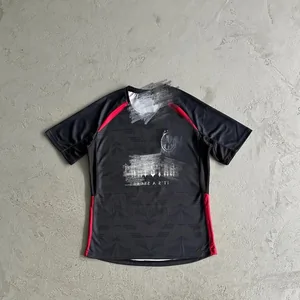 Sports jerseysConfirm the cut and any name or number printing.Category
 HatsLook for head circumference and the closure.Category
 BeltsMeasure to the middle hole, not the full strap.Category
 EyewearCheck frame width; a photo cannot prove UV protection.Category
 JewelleryCheck dimensions and the stated metal.Category
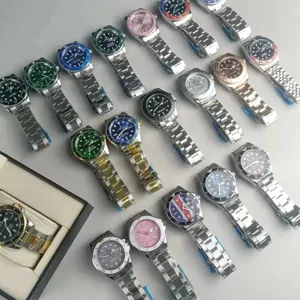 WatchesAsk about movement and battery restrictions.Category
 PerfumeConfirm liquid acceptance before ordering.Category
 ElectronicsCheck battery, plug and model compatibility.Category
The catalog
What the Mulebuy Spreadsheet is
What we add is a way to judge a find before you pay. A single card tells you what one seller asks. Five similar cards tell you whether that ask is ordinary. The Spreadsheet page lists every shelf with the thing to match first on it.
Comparables, the habit this site is built on
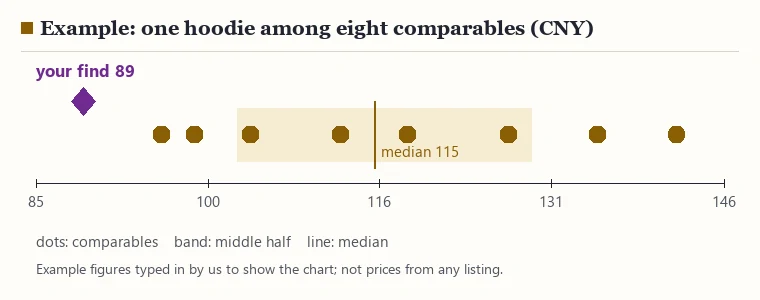
Appraisers price a house by looking at similar homes sold nearby, and they call those homes comparables. A catalog find can be read the same way: gather three to eight listings that sell the same kind of item with similar stated details (same shelf, same fabric or material, similar size range) and see where your find lands among them.
In the example below, a plain zip hoodie listed at 89 yuan sits under every one of eight comparables, whose middle half runs from about 103 to 129 yuan. That does not make it a bad buy. It means the listing owes you an explanation, and the place to look is the fabric line, the option menu and the photo set. The comparables tool draws this chart for your own numbers and tells you what to ask next.
Mulebuy itself, in October 2026
Mulebuy was a China shopping agent: you sent it a marketplace link, it bought the item, checked it at a warehouse in Guangdong and posted it to you. Through the summer of 2026 it published notices about shipping lines and fees, the last one dated July 31.
This month its website has not loaded for us. Our own check, with the date and what the browser returned, sits at the top of the About Mulebuy page, together with what its help pages said while they were online. Everything this site says about Mulebuy is written in the past tense for that reason, and nothing here links to its old sign-up page.
The catalog does not depend on any one agent. Every card is a link to a seller, and any agent that accepts marketplace links can buy from that seller.
The route from shelf card to front door
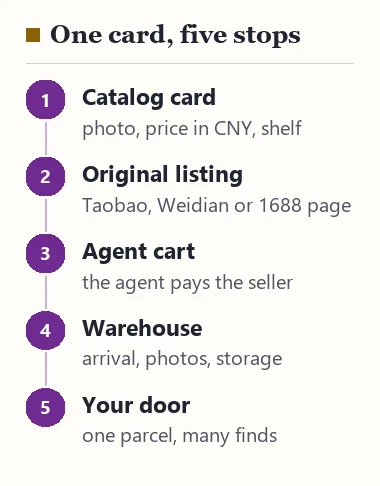
The finding guide walks through the whole route in ten steps. The short version: search or browse, open the original listing, collect comparables, decide on the option and size, then paste the link into an agent’s cart. You pay for the item and the seller’s domestic delivery first; international shipping is paid later, once your items have reached the warehouse and you know what they weigh.
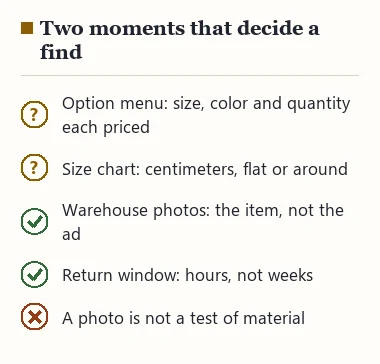
Two moments decide most outcomes. The first is the option menu on the listing, where size, color and pack quantity each carry their own price. The second is the warehouse photo set, the only time you see the real piece before it ships out of China. Picking a listing covers the first, QC photos the second.
From comparison to a purchase decision
Warehouse photos, read as evidence
When a seller’s parcel reaches an agent’s warehouse, staff open it, check the item against your order and photograph it. Mulebuy’s help pages in August 2026 promised three to seven standard photos at fixed angles, free, and sold extra photos at CNY 1.5 each.
Four agents that were open this month
With Mulebuy offline, the catalog links still work through other agents. We put four side by side, all of them accepting orders in mid-October 2026: LoongBuy, Tigbuy, iTaoBuy and JoyaGoo.
Help, words and what changed
If a term on this site is new to you, the help page has a short glossary (QC, consolidation, volumetric weight, rehearsal packing and more) and short answers to what readers ask us most. Costs are broken down on fees and exchange rate , and the route home on shipping a haul home .