Home / Picking a listing
How to choose a listing, and the seller behind it
A listing is a set of claims made by one seller. Read them in a fixed order, then test them against listings of the same kind.
Reviewed October 20, 2026
Read a listing in this order
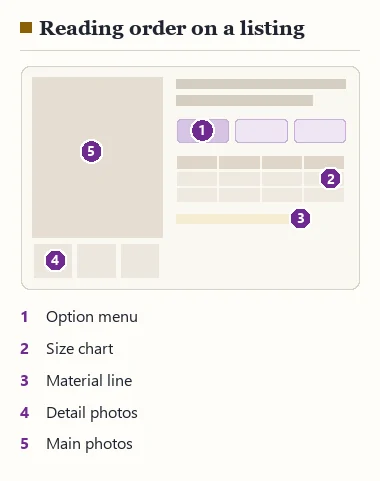
How to choose an item from a marketplace listing comes down to reading its parts in an order that puts the hard facts first. We use this one:
- Option menu. What exactly is for sale, and at what price per size and color.
- Size chart. Measurements in centimeters, and whether they are taken flat or around the body.
- Material line. Fabric content, weight or metal, if stated.
- Detail photos. Seams, labels, hardware, inside of the garment.
- Main photos. Last, because they are the most styled.
Main photos sell; the menu and the chart describe. Reading backwards from the photos tends to anchor you on how the item looks in perfect light, and every later fact gets bent to fit that first impression.
Building a comparable set that means something
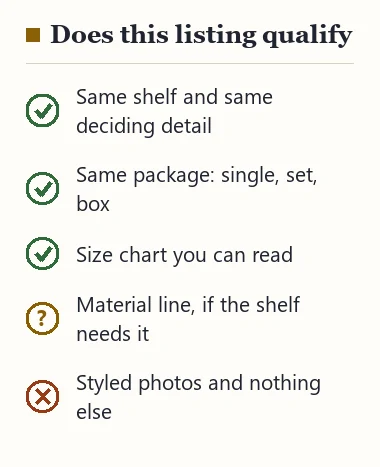
A comparable must match your find on the details that drive cost. Same shelf is the start, not the end. For a hoodie, match the lining and whether it zips. For jeans, match the leg shape and the finish. For a bag, match the size and the material. The shelf notes list the deciding details for all sixteen shelves.
Then match what is being sold. Some listings sell one item; some sell a set with a matching piece; some include a gift or a box. Price the same package across the set, or note the difference beside the price.
Finally, drop listings you cannot read. A listing with no size chart, no material line and only styled photos is not evidence of anything. Three readable comparables beat eight vague ones. When you have your set, the comparables checker shows where your find sits.
When several listings share one photo
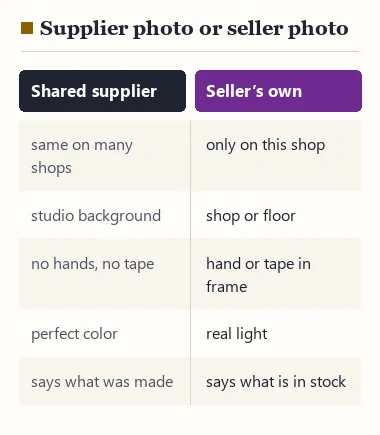
You will often find the same main photo on listings from different shops. Marketplaces are full of resellers who copy a supplier’s images. That alone is not a warning; the item may come from the same supplier. But it changes how you read comparables.
If five listings share a photo and four of them price within a narrow band, the outlier is the interesting one. A much lower price can mean a different fabric or an older stock; a much higher one can mean a shop that adds checking or better packing. Look for the seller’s own photos (a hand, a tape measure, a shop floor) to tell who has the item in hand.
Shared photos also mean the warehouse photos are the first real look at the item. Plan to read them carefully, as described on the QC page.
How to judge a seller from outside China
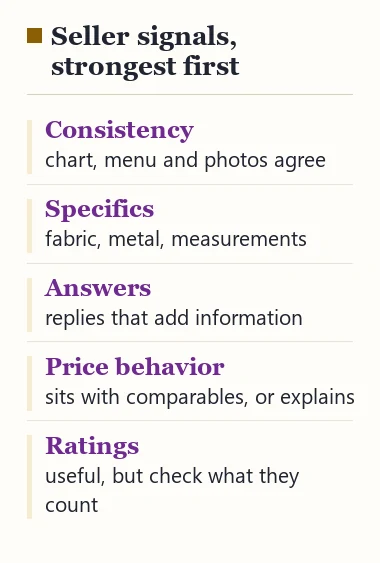
Choosing a seller is harder from abroad because the marketplace’s own signals are partly hidden or in Chinese. Your agent’s copy of the listing usually shows the shop name and sometimes sales counts. A few signals still carry weight:
- Consistency. The size chart, option names and photos agree with each other.
- Specifics. The listing names fabric content or metal, gives measurements, and shows details such as care labels.
- Answers. When your agent asks a question (does the 80 kg size come in black?), the seller replies with a specific answer, not a copy of the listing.
- Price behavior. The price sits in a plausible place among comparables, or the listing explains why it does not.
Shop age and ratings help when you can see them, but treat a big sales number with care: it may count a cheaper option or an old version of the item.
Asking a seller a question through an agent
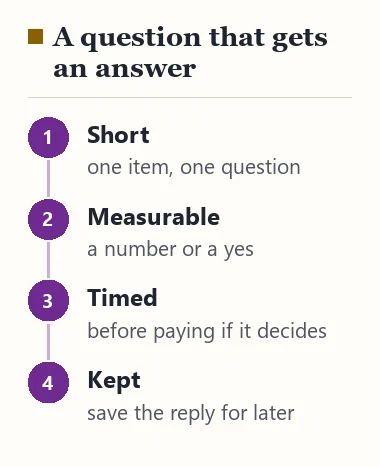
Nearly every agent gives you an order-note field or a ticket form, and their staff contact the seller in Chinese. Questions work best when they are short and answerable with a number or a yes: What is the chest width of size L laid flat? Is the black the same fabric as the gray? Is the box included in this option?
Ask before you pay when the answer would change your choice; ask in the order note when it only affects checking. Keep a copy of the answer. If the warehouse photos then contradict that answer, the saved reply is what you point to when you ask for a return.
If the seller has not replied after a day or two, the agent will usually say so. Silence on a simple measurement question tells you something about the shop, and it is a fair reason to move to the next comparable.