Home / Fees and exchange rate
Fees and exchange rate: the cost breakdown of one find
A catalog card shows only the first of several charges. Here they are in the order you meet them, with the figures Mulebuy published in 2026 and what the open agents published in October.
Reviewed October 20, 2026
The layers of a cost breakdown
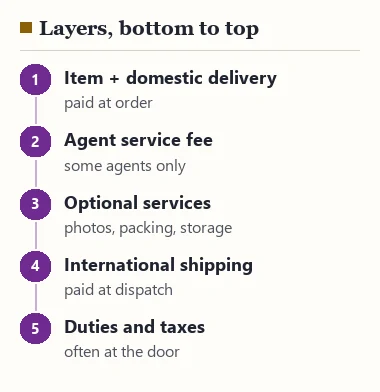
Think of the total as layers. At the bottom sits the item price and the seller’s domestic delivery, paid when you order. Then any agent service fee, which some agents charge on the order and some do not. Then optional services: extra photos, packing, storage beyond the free period. Then international shipping, paid when the parcel leaves. Finally duties and taxes at your border, sometimes prepaid in the shipping price, more often collected on arrival.
Comparables help only with the bottom layer. Two finds with the same price can end up costing different amounts once the upper layers are added, mostly because of weight. So a fair comparison between two finds adds the expected shipping too, which is why the shipping page sits next to this one.
Agent service fees, compared
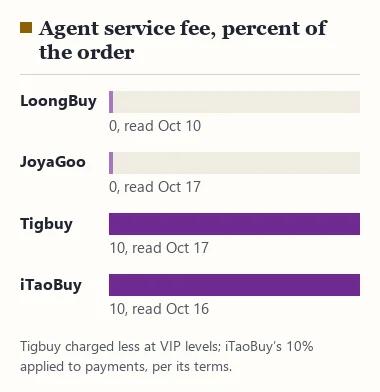
An agent service fee is a charge for buying on your behalf, usually a percentage. Mulebuy charged none: its FAQ in August 2026 called a zero service fee its philosophy. That did not make the whole order free; it still collected per-parcel charges, covered below.
Among open agents in October 2026, LoongBuy described a zero service fee mode and JoyaGoo called its agent service free, while Tigbuy charged 10% of the item price plus China freight (less at higher VIP levels) and iTaoBuy’s terms set a 10% technical service fee on top-ups, order payments and international freight. A 10% fee on a 150-yuan find is 15 yuan, which is small next to shipping but adds up across a large haul. The agents page has the full comparison with dates.
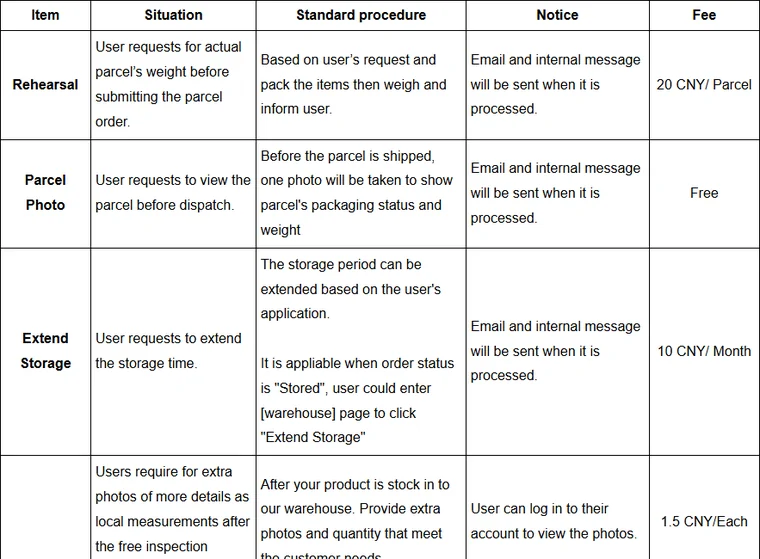
Mulebuy’s fee table as it stood in August 2026
Mulebuy’s services fee page listed the optional charges in one table. Rehearsal packing, where the warehouse packs a parcel in advance so the actual weight and box size are known before you pay the postage, cost CNY 20 per parcel. The parcel photo before dispatch was free. Extending storage after the free 90 days cost CNY 10 a month, and only within 30 days of expiry; after that, the item could no longer be submitted for shipping without contacting support. Extra photos cost CNY 1.5 each.
Two per-parcel charges sat outside the table. A customs declaration base fee was collected on each parcel, which its FAQ said typically started at USD 1.18. And from June 24, 2026, parcels to the European Union carried a fixed EUR 3 per parcel, a change that followed new EU rules on low-value imports. The archived table is shown below.
Returns, top-ups and withdrawals
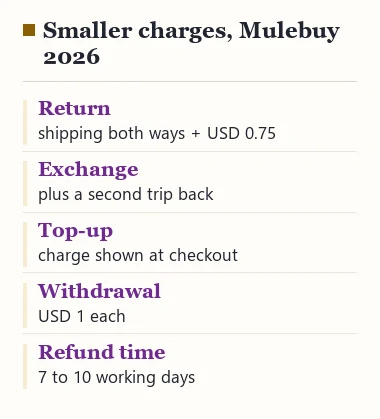
Returns carry their own costs. Mulebuy charged domestic shipping to the seller and back plus a USD 0.75 handling fee when the buyer caused the return; its FAQ described the handling charge differently, but the return page was the one that set the fee. Exchanges added a second trip from the seller.
Money in and out also costs something. Mulebuy took a service charge on top-ups, shown at checkout and varying by payment method, and charged USD 1 per withdrawal, with refunds going back the way they came within seven to ten working days. It accepted cards, PayPal, Apple Pay and Google Pay, Alipay and several European methods including Klarna, iDEAL, Blik and PayU, depending on country. Open agents publish their own charges; read the top-up screen before you load a balance.
Measuring the gap in an agent’s exchange rate
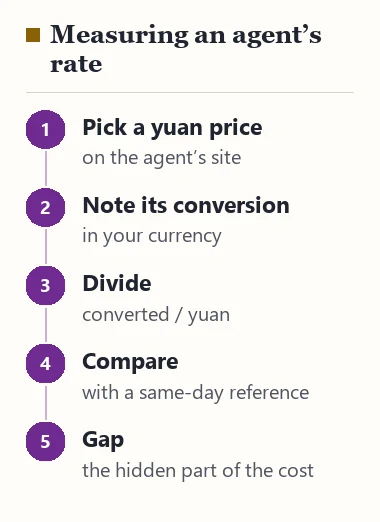
Sellers price in yuan. Your agent converts that into dollars, euros or pounds at a rate it sets, and that rate is almost always above the mid-market figure a currency converter shows you. That difference is a cost, folded into every price you pay, and agents rarely list it as a fee.
You can measure it in a minute. Take a yuan price on your agent’s site, note the converted figure it shows, divide one by the other, and set the result beside a reference rate published that day. The size of the gap differs from agent to agent and from currency to currency, which is the reason to measure it yourself. Mulebuy’s own help pages described the basis of its rate in two different ways in 2026, which is a reason to measure rather than read.
When you compare agents, compare the converted total for the same basket, not the fee list alone. A zero service fee and a wider exchange gap can cost more than a small fee and a narrow one.