Home / Shipping a haul home
Shipping a haul home: one parcel, two weights, many lines
International shipping is paid last and usually costs the most after the items themselves. Two numbers decide it: what the parcel weighs, and how much space it takes.
Reviewed October 20, 2026
Many finds, one parcel
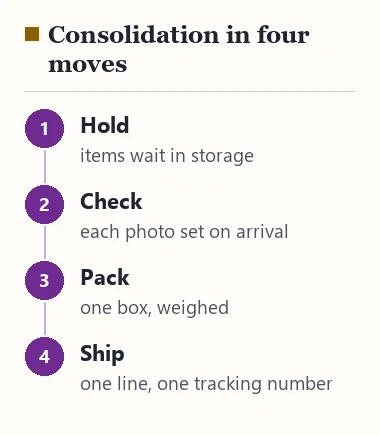
Agents let you hold items at the warehouse until you are ready, then pack several into one international parcel. That is consolidation, and it is usually cheaper than sending each find on its own, because most shipping lines charge a first-weight price for the opening block and a lower price for each block after it.
The trade-off is time and storage. Every item has its own storage clock from the day it arrived, typically 90 days free at the agents we read, and its own return window, which closes long before you ship. A sensible rhythm is to buy in a short burst, read each photo set as it arrives, then ship once the last item is in.
Before the parcel leaves, many agents show you a photo of the packed box and its weight. Mulebuy’s help pages in August 2026 listed that parcel photo as free.
Actual weight and volumetric weight
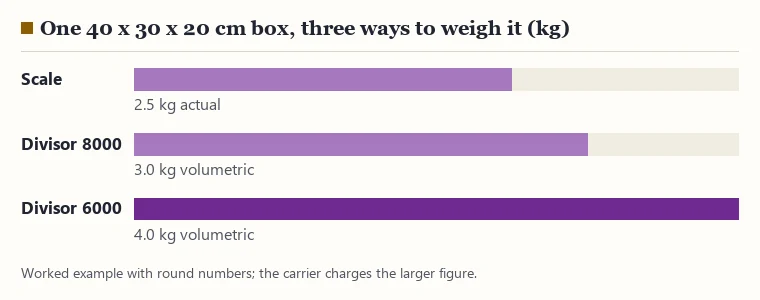
Carriers charge by whichever is larger: the parcel’s actual weight on a scale, or its volumetric weight, which turns size into kilograms. The formula multiplies length, width and height in centimeters and divides the result by a figure each carrier chooses. Mulebuy’s help page on shipping weight, as archived in August 2026, gave that divisor as 5000, 6000, 7000 or 8000 depending on the carrier.
A worked example with round numbers: a box of 40 × 30 × 20 cm holds 24,000 cubic centimeters. Divided by 6000 that is 4 kg; divided by 8000, 3 kg. If the clothes inside weigh 2.5 kg, you pay for 4 kg on the first line and 3 kg on the second. Bulky, light finds (puffer jackets, shoe boxes, structured bags) are where volumetric weight bites. Asking the agent to remove shoe boxes or to vacuum-pack soft items can bring the box down, at the cost of the packaging.
Kinds of shipping line
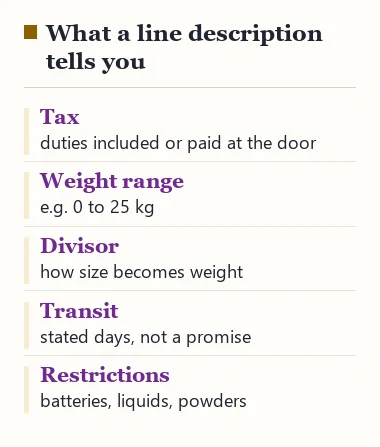
Agents sell several lines to each country. They differ in carrier, speed, price, which items they accept and whether duties are included. Mulebuy split its lines into two kinds in 2026: self-operated lines run with its partners under its own after-sales standard, and other lines that followed the carrier’s compensation rules.
Its notices from May to July 2026 named lines by code and described each one by tax treatment, weight range, divisor and transit time. One July notice, for example, introduced an EU line marked duty free, for parcels of up to 25 kg with a divisor of 8000 and a stated 12 to 18 days in transit. Those details are history now, but the way to compare lines has not changed: match weight range, divisor, whether duties are paid in advance, and which items are refused.
The domestic leg before it all
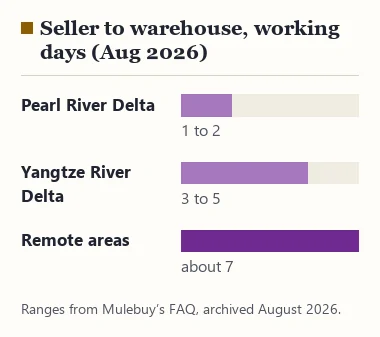
Before anything ships abroad, each item travels inside China from its seller to the warehouse. Mulebuy’s FAQ in August 2026 gave rough times: the Yangtze River Delta took three to five working days, the Pearl River Delta one or two, and remote provinces around seven. An item marked received still had to be weighed and checked before it showed as stored.
That leg explains why finds from one order arrive on different days, and why the return window for each item starts at a different moment. When you buy from sellers in different provinces, expect the haul to assemble over a week or two.
Tracking, delays and lost parcels
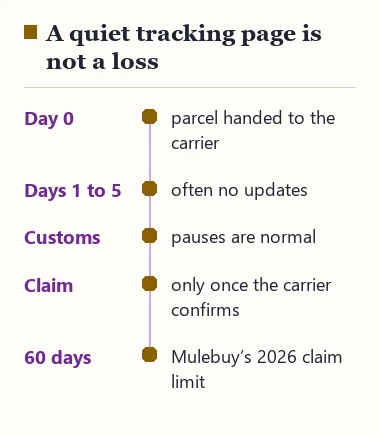
A tracking number comes with dispatch. Updates can stop for days, especially while a parcel waits for a flight or sits in customs. Mulebuy’s blog made the point in July 2026 that a tracking page left unchanged for some days is no evidence of loss; only the carrier can confirm one.
Insurance rules differed by line. In Mulebuy’s 2026 interface, paid parcel cover cost 3% of the item value plus shipping, with a minimum of CNY 25, and a claim had a 60-day limit counted from dispatch; lines without paid cover compensated by the line’s own rules. Read your agent’s version before you choose a line, since what one agent calls free cover may pay out very little.
Taxes at your border are separate from shipping. Some lines include them, most do not.